نوع مقاله : مقاله پژوهشی
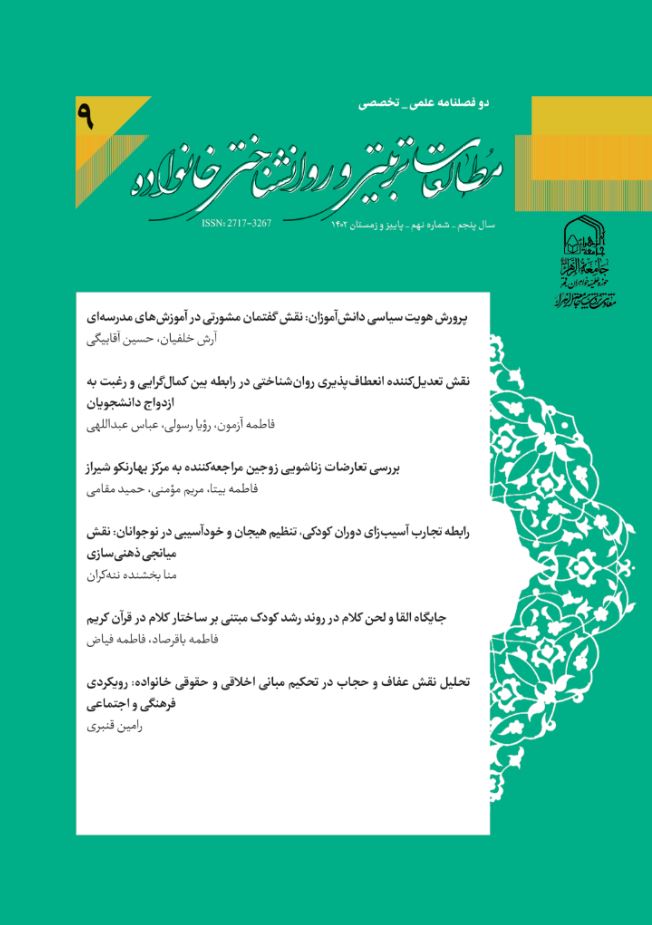
Developing Students' Political Identity: The Role of Deliberative Discourse in School Education
Arash Khalafian[1]
Hossein Aghabeigi[2]
[1]. B.A. in General Psychology, lecturer at Bahonar Farhangian University of Isfahan. (Corresponding author) arashkhalafiyan2@gmail.com
[2]. M.A. in Accounting, Teacher of the Education Department of Khuzestan Province, hoseinaghbeigy@gmail.com
Abstract
In today's changing social and cultural world, the acceleration of developments, especially in the last few decades, shows the transition of society to a new stage in terms of structure and culture. So, the issue of generational differences, the increasing distance between generations, and the need to cultivate political thinking and political understanding in the adolescent and young generation, especially in the context of their political participation, is raised as a vital category for explaining the future of the country. Political sociologists have defined attitudes as value assessments of a phenomenon, whether positive or negative, and pre-formed responses to it, in favor or against, however, existing empirical and theoretical studies indicate a failure in the synergy of political norms in the family, society, and school. The lack of coordination and incompatibility between the values learned in different social institutions and educational institution, especially in the context of undesirable politicization of adolescents proved the above case. The present study seeks to examine and explain the process of education and development of student’s political taste through conducting political consultative discourse in the school education system. The research method is descriptive-analytical and based on data collection in a library manner. The findings revealed that political education and training, with a holistic and future-oriented perspective, strengthened the political identity of students and changed the current situation towards a desirable situation, then not only it led to the formation of constructive political participation, but also provided the necessary basis for the active and conscious participation of this generation in the social and political arenas. Since one of the fundamental goals of the Islamic Republic of Iran is to educate revolutionary individuals familiar with the world of politics, it is suggested that in the educational system development plan, by designing appropriate infrastructures for implementing dialogue-based methods and negotiation discourse, students' political skills be strengthened and the ability to correctly understand the attitudes and points of view of experts in the classroom and media be effectively institutionalized.
Keywords: Education, attitude, political growth, group discourse, students