نوع مقاله : مقاله پژوهشی
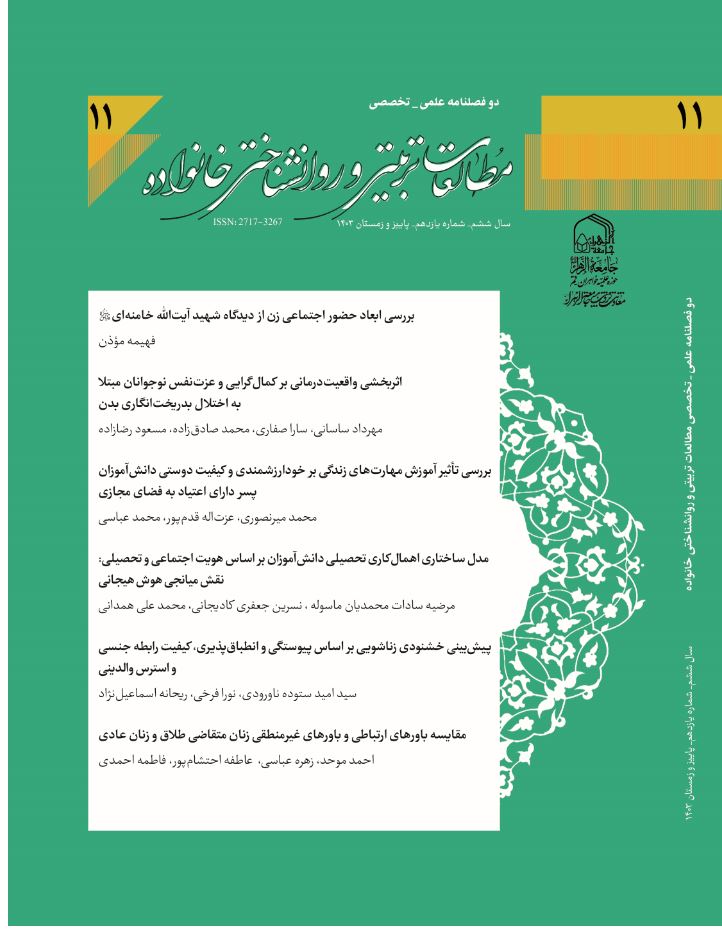
A Structural Model of Students' Academic Procrastination Based on Social and Academic Identity: The Mediating Role of Emotional Intelligence
Marzieh Sadat Mohammadian Maasouleh[1]
Nasrin Ja’fari Kadijani[2]
Mohammad Ali Hamedani[3]
[1].Master of Educational Psychology, Faculty of Humanities, Islamic Azad University, North Tehran Branch. Tehran. Iran. (Corresponding author). marziyehmohammadian931@gmail.com
[2] . PhD in Educational Psychology, Department of Psychology, Islamic Azad University, North Tehran Branch. Tehran. Iran Dr.jafarik7@gmail.com
[3]. PhD in Islamic Revolution of Iran, University of Education; Master of General Psychology, University of Religions and Denominations. Qom. Iran. Psyhamedani@gmail.com
Abstract
The present study aimed to determine the structural model of academic procrastination based on social identity and academic identity with the mediating role of emotional intelligence among students. The research method is descriptive-correlational and based on structural equation modeling (SEM). The statistical population included all male and female students in the humanity sciences of the second high school in Tehran in the academic year 1402-1403, and 260 people from this population were selected using a multi-stage cluster random sampling method and based on the principles of the Tabaknik and Fidel table.The data collection tools included Tuckman's Academic Procrastination Questionnaire (1991), Saffarnia and Roshan's Social Identity Questionnaire (2011), Vaz and Isaacson's Academic Identity Questionnaire (2008), and Bradbury and Graves's Emotional Intelligence Questionnaire (2005). Data analysis was performed using descriptive statistics and structural equation modeling. The results showed that social identity and academic identity have a significant effect on students' academic procrastination, both directly and indirectly through emotional intelligence (p<0.01). It was also found that higher levels of social and academic identity and emotional intelligence are associated with lower levels of academic procrastination.These findings emphasize the need to strengthen social identity, academic identity, and emotional intelligence components in educational programs and psychological interventions and suggest that increasing these variables can lead to a decrease in academic procrastination in students.
Keywords: Academic procrastination, social identity, academic identity, emotional intelligence, high school students, female students.